
Thu Nov 20 2025OurDestinations
Bow Yoho Traverse Dec 29-Jan 1 2019
Here's a look back at a past adventure with guide Tom Wolfe -- we are excited for similar trips this upcoming winter with slightly longer days and warmer temperatures both March 15–21 and April 13–18, 2026. If you’re interested in joining Sawback for a Bow Yoho Traverse trip, reach out with any questions you may have, or click here for the trip info page and to make a booking online.
I completed a 4-day ski tour of the Yoho Traverse yesterday with a very hardy group of Saskatchewaners. We experienced very cold temperatures, ranging from -35 C to -17 C. Face protection in the form of buffs and goggles were essential at times, especially on the glaciers, and toe warmers helped keep things as comfortable as possible.
On the first day of our trip there was about 25 cm of new snow that fell on the faceted surfaces. We found some thin buried wind slabs on ridgetops. There was excellent calf-deep skiing in sheltered locations.
The icefall below Mt. Collie is easily navigated with good visibility but would be a challenge in poor visibility. While we didn’t walk over any obvious bridges and it seems well filled in, photographs of the icefall from a few weeks ago show that it is riddled with crevasses. There was an average of around 130 cm on the glaciers (we probed as little as 90 cm) and we kept the rope on for almost the entire glacier portion of the traverse.
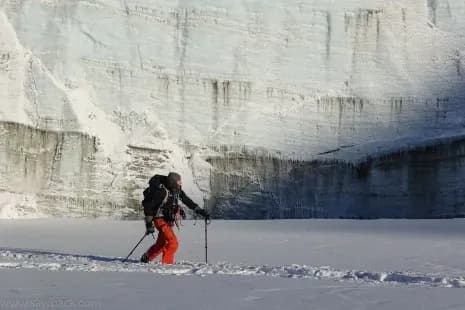
The toe of the Des Poilus Glacier is a very large, vertical ice cliff. This is easily avoided by crossing early to the skier’s right (west) side of the glacier (see photo; the ACC and Parks Canada have excellent information on the route to and from Guy Hut).
Avalanche hazard was Moderate (2) in the alpine and treeline and improving by the day. We had one skier-triggered avalanche on New Year’s Eve: a small size 1 that did not propagate beyond my ski tracks, occurring around a protruding faceted rock. It was sluggish and did not move far. 38 degrees, south aspect off the top of Isolated Col (2400 m), down 20 cm on a thin buried wind crust over facets, 10 m wide, ran 20 m (see photos). Apart from that we had no signs of cracking, whoompfing, or shearing during the entire trip, including ski-cutting steep rolls on the north side of Isolated Col, which we skied wall-to-wall with eight sets of tracks. A test profile at 2100 m, north aspect (Isolated Col) had broken results down 20 cm.
By the end of the trip the alpine looked wind-affected on some larger open slopes like the McArthur Glacier and below the Presidents.
If you plan to stay at the Guy Hut soon, be sure to check about the lock. We were not expecting the hut to be locked. I’ve reported this to the ACC and they should be aware of it now.
The slope above the hut is very thinly covered in snow (0–30 cm) and littered with sharp rocks. Careful!
Also, the days are short and the margins for wasted time are tight getting from the Bow Hut to the Guy Hut before dark at this time of year. We left in the dark at around 8 am and found that gave us enough time with a couple of hours to spare, but we moved swiftly and without problems — critically important in the extreme cold and moderate winds we experienced that morning.
Yesterday, as we shivered in the valley bottom at -17 C, we heard that Parks Visitor Safety measured +1 C on the Wapta during a rescue. Hard to believe such a radical inversion.